Showing posts with label Alps. Show all posts

Wednesday, 12 January 2011

Photos from my Schnaels Valley trip last September and again in October

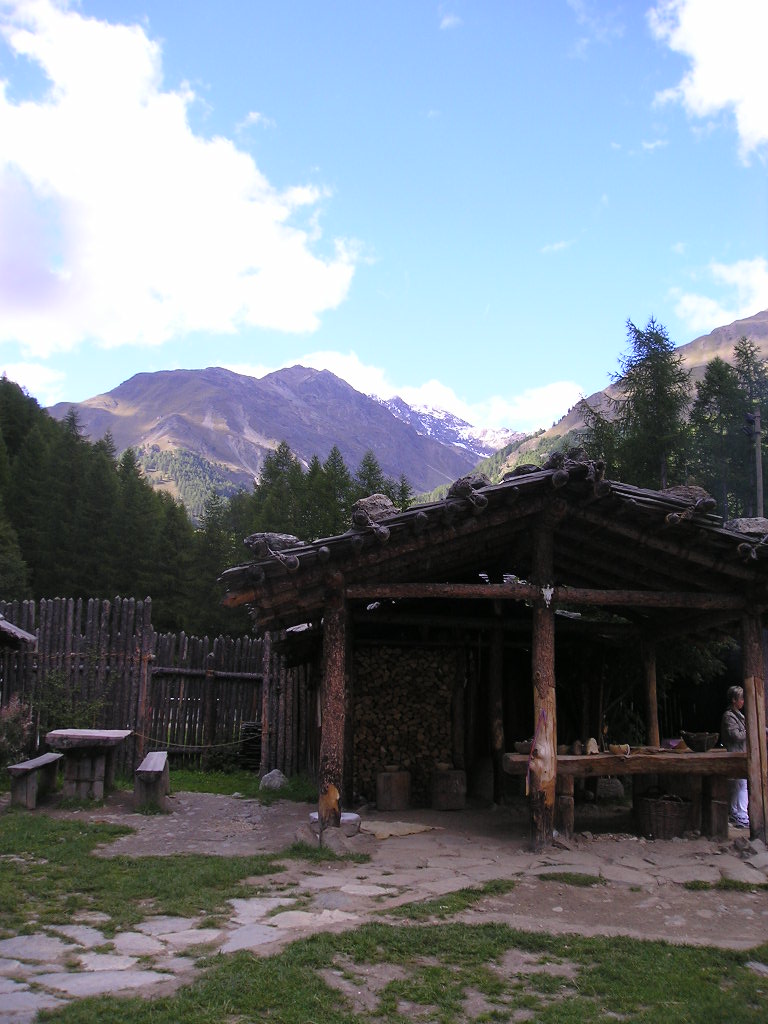
Back in early September I took a week off of a busy schedule attending academic geology conferences and short courses to attend the Second Annual European Textile Forum—a conference designed for both academics and living history enthusiasts who are interested in historic textiles. As a long-time participant in historical recreation events who loves hand-sewing and is fascinated with ways in which fabric and other textiles are created I really enjoyed the chance to meet and mingle with others who also love the subject. As with the textile forum of the year before, I reveled in living in a historic setting—this time we were at the Archeoparc in the Neolithic, surrounded with tools found with Otzi, the Ice Man.

However, for me the wonderful people met and the sharing of information on any number of textile arts was only part of the joy in the week; the rest of the joy was the setting itself. The Senales valley is a place of beauty, and it was fun to get out and look at bit at the rocks. I so enjoyed my week there that I returned again in October when my mother was visiting and did some more exploring. Here are some of the highlights of the geology I saw in my explorations of this valley in the Italian Alps.

One of the cute little farms in the lower part of the valley:


And the near-by outcrop:


The view above the Archeoparc historical buildings:

The church just downhill from the park (and some nice outcrop to the left):


Much of the rock of the part of the valley where we were staying is a lovely fine-grained schist:


In places the locals use the rock to form part of their storage sheds:

In other parts of the hiking trail up the valley it is just a pretty part of the landscape:


Not far uphill from the Archeoparc there is a damn which holds back a cute mountain lake, though I'm told that there are people who are still annoyed about losing their family farms when it was put in.

The schist gets coarser as one works one's way further uphill towards the ski resort:


In places there are some lovely quartz boudins:


I saw some pretty clear contacts:


In October there was already some decent snow on the peaks; I wonder how it looks now?

Sunday, 5 September 2010

A short course in Vienna

As I type (Saturday morning 4 Sept 2010) this I am sitting on a train, traveling from Vienna to Zurich, where I will change trains for my trip home from my latest adventures. The plan, when I scheduled the travel was to enjoy the mountain views out the window, but the clouds are low, so while I can tell that there are hills out there, I can’t tell if they rise up into mountains. However, as we passed Salzburg I did get glimpses of the peaks as the clouds parted, so the time spent on the train will have been worth it for that view, if no others come along. With luck I will get a chance to post this once I’m home, since I don’t expect to have any internet access at all next week.
After leaving Budapest and the IMA conference I traveled first to Salzburg, where I spent the weekend playing tourist and visiting the salt mine at Hallein (photos from that trip to follow in another post), and then doubled back to Vienna, where I attended a short-course on the Kinetics of Geologic Materials.
The course turned out to be as useful as I’d hoped. I signed up for it in large part because, having had such a long break between taking my last math course and enrolling in my PhD program, I’d found that when reading papers I had a tendency to skip over formulas and jump to the next descriptive part of the text. In an effort to overcome this habit I have checked out text books on the thermodynamics behind the chemical reactions which form minerals, and, to some extent, they helped. However, I still felt like I was missing something in my understanding of the math/formulas that one needs to describe what is happening during mineral-forming reactions, and so this course.
There were more than 25 of us who signed up for the course, traveling there from Italy, Germany, Hungary, the Czech Republic, and more. We range in experience from advance undergraduate geology students to post-doctoral researchers. At the end of our course we shared information on our current research in a poster session ( good percentage of us had attended the IMA conference in Budapest), and our specialties range from experimental studies to traditional petrology—from the crystallization of minerals from a melt, to zoning in metamorphic minerals and a number of points in between. One student is even studying the ability of rocks in Hungary to store man-made CO2.
The lectures started with an introduction to thermodynamics—the study of the relationship to the energy of a system to the equilibrium thereof. The common physical example used to illustrate this point is to stand a rectangular block on its narrow end. So long as it is on a flat surface and nothing happens to it, it will happily stand there all day. However, being taller than it is wide, should anything bump into it the block will fall over and land on its broad side. We describe the block standing on its narrow end as “metastable”, because if energy is added (it gets pushed), it will transform to its more stable state of lying on its broad side. Chemical reactions are much the same. Minerals are each stable in a specific range of conditions (pressure, temperature, and composition of the rock itself), but some chemical reactions take more of a “push” to make them happen than others. In these cases the minerals will often exist in conditions during which they are not expected to exist, in which case, like the block standing on its narrow side, they are metastable.
From this simple example the course built up the mathematical framework of how to describe the energy used to “push” the reactions into happening, and how to use published values for that energy to determine for any conditions what minerals will be expected to be stable in an equilibrium situation. We touched on many related topics related to kinetics, including diffusion (how the elements within the minerals move from one location to another so that the chemical reactions will happen), nucleation (the earliest stages of the growth of a new crystal), and the boundaries between grains and/or phases. For most topics presented we also had exercises to work on during the lab hours—using MATLAB to perform calculations on these processes for model (simplified) systems.
All in all the week was a very valuable experience, but train has reached an area where the mountains are visible, so it is time to shut down the computer and enjoy the view.

Saturday, 21 August 2010

My flight to Budapest

I flew to Budapest this morning, to attend the upcoming IMA2010 Conference (Aug. 21-27, Budapest). When I finally turned on the computer this evening there was an e-mail from the conference organizers announcing that this event “includes in its programme 13 plenary lectures: seven IMA2010 Plenary talks and six Elements5 talks (the latter celebrating the 5th anniversary of our excellent journal). The topics cover all representative areas, and they are tailored for a broad audience, while the authors are well-recognized experts in their fields, but also attractive speakers.” They also announce that those of you who weren’t able to come out for the meeting can still follow along at home by listing to their live web casting (end public service announcement).

Because I had a morning flight it was necessary to leave my home at 04:00 to begin my journey to the airport. Therefore I decided to just stay up all night, thinking “I can sleep on the plane”. However, what I failed to consider was that the flight path went along the south side of the Alps, for a rather large portion of the range’s extent. Consequently, while I did nap in the bus on the way to the airport, and at the airport itself, I spent the flight with my eyes focused out the window, enjoying the lovely view. Some of the peaks in the second row in still have snow on them, which sight is balm to eyes that have had to endure summer’s heat. I have no idea where I’ll be going when my current contract ends, but I sure hope it is somewhere that I can see (and walk in!) mountains on a daily basis.

Sunday, 21 March 2010

Traveling, again

I took a train across the Alps today, and was reminded, yet again, how much happier I am when surrounded by mountains. While I love my current job, I really do hope that whatever I find to do when this contract ends in December is located in a mountainous area. There is just something about topography which makes me happy. When the topography comes complete with glacially-sculpted valleys, craggy peaks and clearly visible fold and fault structures it is even better. Even though today was a cloudy day, and the southern Alps were barely visible through the lower parts of the clouds, still I spent most of the trip looking out the window (save for the times we were in tunnels, of course—they don’t light those up enough to see the rock-walls, and, I suspect we were going too fast to get a good look at the tunnel-walls even had they been lit up.) The clouds over the northern Alps were nice and high, so my views were clear. The central portion, where there is still snow on the ground was, by far, my favorite part. I so love snow, and miss living places where it stays on the ground after falling.
I am now settled into a hotel room in Zurich, where I will live for the next four days while I attend a scientific writing workshop. It is designed to assist us with every step of the process, from creating a proposal to publication. I am really looking forward to it. While I’m comfortable with the skills required to craft a sentence that says what I meant for it to say, I’m not so comfortable with the process of deciding what parts of an accumulated data set are worth sharing with a general audience—how much is too much, or enough, or not enough? When one knows the flaws in the data, is it still ok to draw some conclusions from it? These are the issues I hope they address this week. However, other students will likely have different needs. It will be interesting to see how it all comes together.

Friday, 31 July 2009

An Alpine Field Trip

Last Friday, just before leaving work for the day, one of my colleagues mentioned to me that two of them would be heading on a field trip on Monday, and would I like to join them? For that sort of question there is only one answer possible.

He then provided me with this much advance information: I was to meet the other colleague at the train station on Monday to catch the 08:00 train to Como, where we will meet the first colleague, get in a car, and head to the field.

Once I arrived at the train station the purpose of the day’s journey was revealed; my colleagues were introducing a new graduate student to his field area. We first drove for about an hour along the western shore of the lake to Gravedona, where we stopped at a sore to pick up some stuff for lunch, and then went up hill from there, first to Dossa del Liro, then on to Caiaso. At our first stop we walked a short way up the gully and spent a pleasant hour looking at the various metamorphic rocks which have been dropped there by the stream in its rush to the lake. The intent was to familiarize the student with the many lithologies which are present in his field area, and more specifically to introduce us to the peridotite (photo to the right--the large garnet is ~2 cm long) so that if we were fortunate enough to find it "in place" later, we'd recognize it. We had along a copy of a 1968 paper which documents the presence of peridotite from the valley in which we'd be hiking, but none of my colleagues were quite certain where in the valley we'd find it.

The hike itself was wonderful--it was a lovely day. Sure, it was hot, but it has been hot every day since I arrive in Europe, so I'm started to adjust, and it was not quite as hot at that elevation (the sign at the trail head said 1000 meters) as it has been in down in the city. Driving up the hill to the trail head I kept seeing lovely old stone houses, and was delighted that there was one at the trail head, and quite a number of them along the trail. Some of the cottages have obviously been abandoned and are in poor repair, but one of the houses has a solar panel on the roof, which I consider to be a good indication that it is still in use today.

Walking up the valley we stopped now and then to admire various rock outcrops, such as this garnet migmatite (left), which is a metamorphic rock which went far enough down a subduction zone that the pressure/heat caused partial melting, or the intricate folds in this one (right).


Late in the afternoon we’d hiked far enough up the valley to reach a good-sized patch of snow that has survived the summer heat. I suppose one could call it a glacier, as the snow obviously stays year-round, yet it clearly doesn't have sufficent mass to cause the metamorphic crystallization of the ice in the lower levels, nor to flow down hill.


Just down hill from the snow-patch, I discovered some truly yummy wild strawberries, a true highlight of the day. I must confess that I ate most of them before remembering that I've a camera in my pocket, and it might be nice to record them for posterity. Fortunately, there was one remaining when I thought of it...


All in all it was a wonderful day, and I am so very glad I went. It was a joy to get out of the city, and to see some mountains! It was interesting listening to the various lectures on the rocks given the graduate student in the local language, as there are a number of geologic terms which are the same (or close enough to the same) in both languages, so I was able to understand more of those lectures than I did the random bits of other conversation that were scattered across the day. (Fortunately for me, both of my colleagues speak English and remembered to include me in conversations on a regular basis, but I do look forward to the language course they say I can take come September, I would like to be able to communicate a bit in the local language.)