Showing posts with label travel. Show all posts

Monday, 10 October 2011

texture short course, day one

Back at the beginning of the summer I saw an ad for a workshop on texture analysis to be held in Tromsø in October open to students and researchers. It sounded interesting, so I sent them a note asking if it was open to researchers who are between contracts, and they said that it was, and (more importantly given the "between contracts" part, the only course fee would be to cover the copying expenses. When I got the job offer for the position I will start on 1 Nov. I asked if he thought I should attend the workshop, or if my time would be better spent staying home and reading literature directly relevant to the project. After looking over the flyer for the course he said that he thought I should go.

It turns out that the most efficient way to get to Tromsø from Luleå is to drive—they have no train this far north, so one would have to switch to a bus part way there, and flights go south to Stockholm and then west to Oslo or Trondheim before heading back north again. Therefore I checked with a friend of mine who is a graduate student with a flexible schedule, and he thought a road trip sounded like a good idea (besides, going away for a week might actually get him to do some writing). We had a nice drive up on Sunday—left Luleå just after 08:00, and arrived at our B&B (located 15 minute walk from the Uni) just after 18:00. (I, of course, forgot to take out the camera once during the drive, since I was so busy gazing out the window at the lovely mountains once we got close to the Norwegian border).

The course is divided into two sections—the first two days we are learning how to use the programs they use here to convert a series of rotated photos of thin sections into data showing the orientation of the crystallographic axes. The technique works only on uniaxial minerals, such as quartz or calcite (or ice), but since these often occur in units which have been deformed it is a useful tool.

It was very enjoyable to be back in a classroom again after a longish break, though a bit of a challenge to keep up with the exercise—the program we are using runs only on MacOS, and I haven't really needed to use Apple computers since my class in programing Basic on an AppleIIe back in highschool. Apple products have changed a bit since then, and while there are similarities in the handling between Apple and PC there are just enough differences that I found myself pushing the wrong button more than once and then frantically trying to undo that and get back to where I was meant to be before the teacher had gotten so far ahead that I couldn't catch up. Sometimes I managed it, sometimes I was the voice saying "wait, what folder was that?".

Fortunately, she was very patient when we got lost, and would back up and explain the steps we hadn't caught so that we could go on to the next step. I think we all managed to convert the raw data into the correct formats and align the stacks of images properly. Tomorrow we get to actually process that data into the sorts of final images that wind up in publications…

Thursday, 4 August 2011

and the adventures continue

My mandatory holiday in Australia, wherein I applied for my visa to move permanently to Scandinavia to live with my partner, turned out to be only three weeks long. This was a long time to be separated from him, but only just long enough to accomplish what I wanted to with the trip. In between visiting with friends and family I managed to get what feels like a good draft of my paper from my PhD research written and handed in to my adviser for his edits/comments, and had some very good discussions with him about the research/experiments I did in Italy that will be useful when I return to finishing up the paper from that project. But before I do that it is time to enjoy the rest of my love's summer holiday with him, and go camping at the Medieval Week in Gotland. Time enough to return to being a scientist after indulging personal interests.

and the adventures continue

My mandatory holiday in Australia, wherein I applied for my visa to move permanently to Scandinavia to live with my partner, turned out to be only three weeks long. This was a long time to be separated from him, but only just long enough to accomplish what I wanted to with the trip. In between visiting with friends and family I managed to get what feels like a good draft of my paper from my PhD research written and handed in to my adviser for his edits/comments, and had some very good discussions with him about the research/experiments I did in Italy that will be useful when I return to finishing up the paper from that project. But before I do that it is time to enjoy the rest of my love's summer holiday with him, and go camping at the Medieval Week in Gotland. Time enough to return to being a scientist after indulging personal interests.

Sunday, 19 December 2010

My travels in 2010

I see that Silver Fox is playing a game wherein we recount the travelling we've done in the past year. That page links to others who have played as well. Since I love travel, and have done a fair bit recently, I thought I'd join in, but I'll start with December of last year, just because many of you have only just finished with this year's AGU:

December 2009: I flew to California for AGU, and while there visited with many friends who live in the area as well, then flew to Seattle for my mother's birthday, and then home to Alaska for the first time in many years.

2010:

January: I returned to Seattle for a few more days with family and friends there, then back to California for a few more days with friends there before returning home from a month-long holiday based around AGU.

February: Attended a short-course on Microstructures in Verbania, Italy

March: attended a Scientific Writing Workshop in Zurich, Switzerland

April: Petrology conference in Tolouse, France

May: EGU in Vienna, Austria

June: Meeting of my research team in Norway (Trondheim, road trip to Florø, and boat trip to Bergen, then train to Oslo for flight home). Also a non-geology road trip to Germany for a Medieval event.

July: two trips for Medieval Dance events, one in Germany, the other in Scotland.

August: Trip to Ireland to visit friends, to Budapest, Hungary for IMA.

September: Kinetics course in Vienna (went from IMA to Vienna, rather than going home in between), and the European Textile Forum in the Italian Alps, followed by the Italian geological society conference in

October: Back to the Italian Alps with my mother, and then we flew off to Finland to meet family there for the first time, then to Scotland for a job interview.

November: to Stockholm, Sweden for another Medieval Dance event.

December: to Cambridge, UK for another Medieval Dance event.

By my count that is 10 trips for geology meetings, conferences, short courses, or interviews, four for medieval dance events, one for medieval textiles, and six for strictly personal reasons. It is a good thing I like travel!

Wednesday, 15 December 2010

motivation, 1000 a day, and winter holidays

A year and a half ago I was finishing up my PhD thesis, working really, really long hours and totally focused on the one goal: finish up before boarding that plane on my way to my first post-doc position. Many of my friends commented at how motivated I was, and I replied that plane tickets are a huge motivator.

Jump ahead to the present and I once again have plane tickets waiting for me at the end of the month, but this time they are taking me to visit friends in Scandinavia and enjoy some real winter weather while I keep applying for jobs. Since my friends will have jobs to go to during the days the prospect of not being quite finished with my current research isn't as worrisome as the prospect of not completing that thesis before boarding the plane to head to a job—I know that it will be possible to keep working, even once funding ends. As a result I have not been putting fort the same sort of concentrated effort I did a year and a half ago, but am instead permitting myself some distractions.

One of the biggest distractions, of course, is the need to continue to apply for all of those positions which sound interesting and related to any of the research I've done to date. Each of these applications takes time, and each has a deadline by which if I have not yet applied they will not consider me for the position. One of the other distractions has been my social life. I flew to Scandinavia on the last weekend of November, and to the UK on the first weekend of December. Both trips were to attend events focused on Medieval Dancing. I very much enjoyed both trips and got to renew some old friendships and make some new friends.

Prior to the first of those trips I had been wondering what to do about my 1000 a day—I had chosen to fly carry-on only, and wouldn't be bringing my computer—this means that I'd need to actually print out a pdf or bring a text book so that I'd have something with me to read from the geologic literature. Sadly, a couple of days before my trip I forgot to read my 1000, thus ending a streak of 321 days in a row. My record, by far, and I am pleased to have achieved it. But oh, wouldn't it have been nice to manage an entire year in a row of reading 1000 or more words from the geological literature?

I know how it happened that I forgot, too. Much the same way as the last time I broke a record-breaking streak. Step one: get into the habit of reading your 1000 right before bed for many weeks running. Step two, switch to reading during lunch for a week or three. Step three: encounter a particularly busy day, with no time to read your 1000 during lunch. Think about it a couple of times during the day that it still needs doing, but only while actively in the middle of another, important task. Finish up everything else for the day, do yoga, brush teeth, crawl into bed, and pick up some fiction. Read till you sleep, and don’t remember that the 1000 hadn't been done till you wake.

Having forgotten I then made a decision to take a hiatus from reading my 1000. I will start back up after the first of the year, but I am taking December off (I wound up taking off much of last December, too, as I traveled and visited friends and family after attending AGU). It is strangely freeing to have one fewer "must do" on my list each day. However, I strongly suspect that I will be very happy to start that task back up again with the New Year.

Sunday, 17 October 2010

transition to day-shift

The past three weeks and a bit have been even busier than usual. My mother arrived from the US on the 25th of September for a visit and stayed through to this weekend. While she was here I took the weekends off to go sightseeing with her one weekend, and to return to the ancestral home in Finland to meet some delightful family I didn’t know I had on the other. In between I’ve been working and preparing a talk for an upcoming job interview.
The Interview will take place starting at 08:20 in the morning, and as a result of that start-time I decided to adjust my schedule to being on day-shift starting from the day I got the letter letting me know the day/time. For those of you who have been working jobs which are tied to “business hours” for years being on day shift is unlikely to sound remarkable. However, I have been in academia for many years now, and am accustomed to setting my own schedule. While I have had occasional things that are tied to a specific day/time (such as conferences), most of what I have had to accomplish has been to deadlines that are not precisely defined (e.g. the degree will be awarded when you’ve completed your research and written the thesis). As a result my sleeping schedule has tended to wander around the clock based on the whim of the moment. Some days I accomplish my most productive work after midnight. Other days it is in the morning, and still others I’ve got the most energy in the afternoons or early evenings. This flexibility has served me well, and permitted me to achieve my goals thus far.
However, if I land the job for which I will be interviewing it will be one of those wherein I will need to report to work during business hours. Therefore for the past couple of weeks I have had two alarms set. One to go off every day at 21:55, to tell me to stop what I’m doing on my computer, go home, do my yoga, and go to bed soon, the other which goes off at 06:30 every morning telling me to get up and start my day. This seems to be working very well. Some days I am aware that it is closing in on 10 pm, and I’m wrapping up what I’ve been working on before the alarm tells me that I need to. Some days I’m so absorbed in my work it goes off and I’m surprised when it does. On those days it is harder to stop, but I have been making myself do so anyway. (Other days I’m not working at all, but only hanging out on line chatting with friends—it is hard to stop that because the clock says so, too, but my friends have been supportive of my wish to be on day shift, and encourage me to actually say good night promptly, even when they are in a another time zone and it is still hours before their bed time.)
One advantage of this schedule is that I am finding it easier to make time in the mornings to go for a run or put on my rollerblades before breakfast. Somehow, even though there are the same number of hours available in a day no matter which ones I choose to be awake (assuming that the total number of hours I sleep is constant), I feel like I can delay the start of my working day more when I get up at 06:30 than when I get up at 09:00 or 12:00 or 16:00). All in all, I pronounce this experiment a success, and feel confidant that should I be offered a job which requires that I be on day shift that I will thrive, even though it isn’t what I have been used to.

Sunday, 5 September 2010

A short course in Vienna

As I type (Saturday morning 4 Sept 2010) this I am sitting on a train, traveling from Vienna to Zurich, where I will change trains for my trip home from my latest adventures. The plan, when I scheduled the travel was to enjoy the mountain views out the window, but the clouds are low, so while I can tell that there are hills out there, I can’t tell if they rise up into mountains. However, as we passed Salzburg I did get glimpses of the peaks as the clouds parted, so the time spent on the train will have been worth it for that view, if no others come along. With luck I will get a chance to post this once I’m home, since I don’t expect to have any internet access at all next week.
After leaving Budapest and the IMA conference I traveled first to Salzburg, where I spent the weekend playing tourist and visiting the salt mine at Hallein (photos from that trip to follow in another post), and then doubled back to Vienna, where I attended a short-course on the Kinetics of Geologic Materials.
The course turned out to be as useful as I’d hoped. I signed up for it in large part because, having had such a long break between taking my last math course and enrolling in my PhD program, I’d found that when reading papers I had a tendency to skip over formulas and jump to the next descriptive part of the text. In an effort to overcome this habit I have checked out text books on the thermodynamics behind the chemical reactions which form minerals, and, to some extent, they helped. However, I still felt like I was missing something in my understanding of the math/formulas that one needs to describe what is happening during mineral-forming reactions, and so this course.
There were more than 25 of us who signed up for the course, traveling there from Italy, Germany, Hungary, the Czech Republic, and more. We range in experience from advance undergraduate geology students to post-doctoral researchers. At the end of our course we shared information on our current research in a poster session ( good percentage of us had attended the IMA conference in Budapest), and our specialties range from experimental studies to traditional petrology—from the crystallization of minerals from a melt, to zoning in metamorphic minerals and a number of points in between. One student is even studying the ability of rocks in Hungary to store man-made CO2.
The lectures started with an introduction to thermodynamics—the study of the relationship to the energy of a system to the equilibrium thereof. The common physical example used to illustrate this point is to stand a rectangular block on its narrow end. So long as it is on a flat surface and nothing happens to it, it will happily stand there all day. However, being taller than it is wide, should anything bump into it the block will fall over and land on its broad side. We describe the block standing on its narrow end as “metastable”, because if energy is added (it gets pushed), it will transform to its more stable state of lying on its broad side. Chemical reactions are much the same. Minerals are each stable in a specific range of conditions (pressure, temperature, and composition of the rock itself), but some chemical reactions take more of a “push” to make them happen than others. In these cases the minerals will often exist in conditions during which they are not expected to exist, in which case, like the block standing on its narrow side, they are metastable.
From this simple example the course built up the mathematical framework of how to describe the energy used to “push” the reactions into happening, and how to use published values for that energy to determine for any conditions what minerals will be expected to be stable in an equilibrium situation. We touched on many related topics related to kinetics, including diffusion (how the elements within the minerals move from one location to another so that the chemical reactions will happen), nucleation (the earliest stages of the growth of a new crystal), and the boundaries between grains and/or phases. For most topics presented we also had exercises to work on during the lab hours—using MATLAB to perform calculations on these processes for model (simplified) systems.
All in all the week was a very valuable experience, but train has reached an area where the mountains are visible, so it is time to shut down the computer and enjoy the view.

Monday, 23 August 2010

before and after

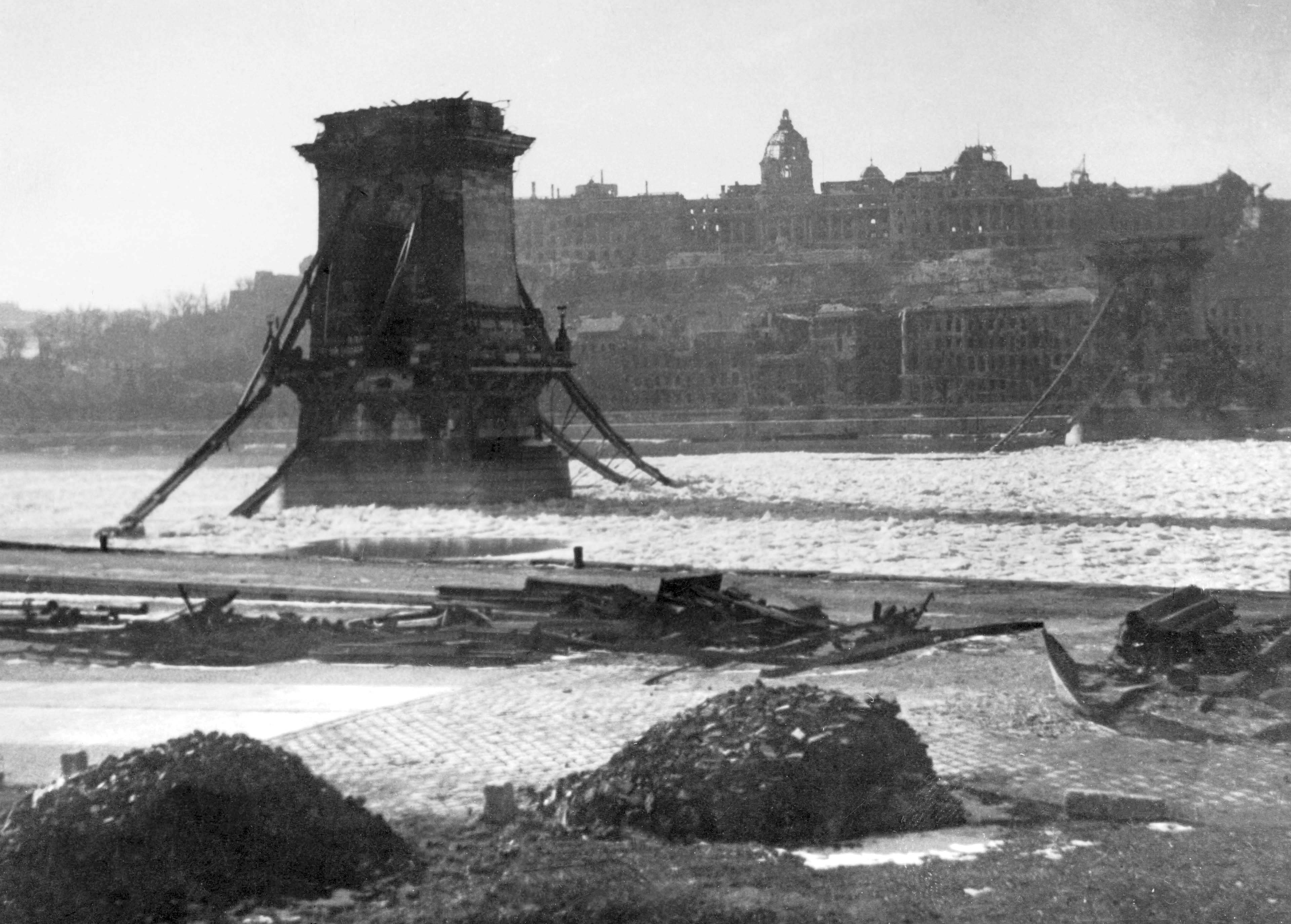
On Sunday afternoon I did a bit of sightseeing in Budapest, with a local guide—a couchsurfer who had stayed with me when he visited my city of residence back in November. Today I posted some of my photos to Facebook, and included the snippet of information that he’d shared with me—apparently all of the bridges connecting the cities of Buda and Pest were destroyed during WWII, but one of them was re-built in the same style as before the war. This is my photo of that bridge:


And this is a link he shared with me of how it looked in 1946.

Seeing his link had me nearly in tears. War is something of which I can never approve, and photos like that really bring home how truly dangerous they are. But the compare and contrast from the destruction then, to the beauty that is now is a tribute to human nature and our ability to sweep up and start over. May we never lose that ability, may we never cause others to need practice that skill, and may we never need practice that skill for reasons of our own causing.

Friday, 23 July 2010

re-finding motivation

How much I accomplish on any given day depends upon a lot of factors. With the heat that has plagued southern Europe recently my motivation levels have been at a very low ebb. The longer the heat lasted, the less motivated I was to do anything near the computer (which generates its own heat, making matters worse). Eventually, in hopes of getting out of the cycle of thinking “I should be working, I’m too hot/miserable to work” I booked tickets to go visit a friend in Scotland for a week, thinking I could bring my computer and get more done while here than I’d been accomplishing at home, even with the distractions of a friend to visit.

Much to my delight, it is, in fact, much cooler here. This morning I enjoyed my first hot shower in weeks (it has been so hot that only very cold showers feel good at home). However, I then had to face a related challenge. One I am aware of, yet still get caught up in now and again. The dreaded “must work/can’t work” mentality often, for me, leads to “work” becoming a vague, nebulous, undefined thing that I “should” be doing, but am not. My first full day in Scotland I spent visiting friends, helping my friend get settled into his new flat, and baking bread and cookies. All with the vague sensation in the back of my mind that I “should” be working, but without any specific thoughts about what “work” means. I find it difficult to actually sit down to “work” when I don’t have a specific task in mind to accomplish.

Fortunately, late last night I took the time to actually open my files, see the list of tasks I have accomplished recently, and what more still needs doing, and I found a specific, identifiable task that needs to be done next. At that point I was much too sleepy to do it, but that is a good thing—this morning, when I woke up, I woke up thinking, for the first time in weeks, about work. About the specific things that need to be done next, so that I may compare the data I’ve been generating with the data that has been published in the literature. In short, I have re-found my motivation. So, with that I leave you and depart to my spreadsheets for an afternoon of fun with data…

Sunday, 16 May 2010

some travel lulls are brief, indeed

Having several days in a row wherein I’m not traveling has been good for me—I’ve actually been making progress transforming my PhD research into a paper, I’ve downloaded my most recent experiment and gotten it polished and ready to analyze with the microprobe on Tuesday, and I even made time to repair my trike, which had been damaged in shipping, so that I can ride it again, since the replacement wheel arrived when I was in Vienna for EGU.

However, this time it is only several days in a row—on Wednesday I’ve a meeting in Siena. I need to decide if I’m going to stay overnight and see something of the area, or simply day-trip (which would make for a long day, since it is a several hour train trip). Then I’ve only one more week to prepare for the trip to Norway for a meeting of our research group.

Tuesday, 11 May 2010

Try and try again

Over the past couple of months I’ve been doing a fair bit of travel for conferences, short course, and writing workshop. Each meeting has been inspirational; each has resulted in additions to the list of things I want to accomplish in terms of research, data analysis, and writing papers for publication. However, the time I spend out of town for each of these meetings, combined with sight-seeing and exploring each new city ± time spent with friends at each location has meant that despite my inclination towards these tasks, the actual number of hours spent engaged in accomplishing them is distressingly low.

This is partially due to the amount of time it takes to arrange the logistics of travel—booking flights, arranging accommodation, packing, etc. and to the amount of time the travel itself takes up. Alas, my computer does not lend itself to in-flight use which so many fellow travelers accomplish—my computer has a battery which holds a charge long enough to properly shut down in case of a power-failure, but not for long enough to be worth turning the computer on unless I have somewhere I can obtain a steady stream of fresh electricity to keep the computer happy. For those of us flying budget airlines, this is not yet an option on flights. Likewise, returning home from a week spent elsewhere results in many urgent small tasks that need doing promptly after my return, all of which add up to not much progress being made on the above mentioned tasks inspired by the meetings.

Fortunately, other than one short trip during the week next week to finally meet in person the people with whom I collaborated on a paper a few years back, I’ve no trips planed until the end of the month. Therefore I state publicly here before you all that my goal is to not only get my next experiment downloaded, polished and ready for my scheduled microprobe analysis next week, but to also finish up at least one of the papers in progress and send it off to my erstwhile advisor for comment before submitting it. Readers who have been following my posts for a while might feel compelled to point out that I’ve stated that particular goal hitherto, but then gotten distracted preparing for upcoming talks on my current research. It is time to try again!

Sunday, 21 March 2010

Traveling, again

I took a train across the Alps today, and was reminded, yet again, how much happier I am when surrounded by mountains. While I love my current job, I really do hope that whatever I find to do when this contract ends in December is located in a mountainous area. There is just something about topography which makes me happy. When the topography comes complete with glacially-sculpted valleys, craggy peaks and clearly visible fold and fault structures it is even better. Even though today was a cloudy day, and the southern Alps were barely visible through the lower parts of the clouds, still I spent most of the trip looking out the window (save for the times we were in tunnels, of course—they don’t light those up enough to see the rock-walls, and, I suspect we were going too fast to get a good look at the tunnel-walls even had they been lit up.) The clouds over the northern Alps were nice and high, so my views were clear. The central portion, where there is still snow on the ground was, by far, my favorite part. I so love snow, and miss living places where it stays on the ground after falling.
I am now settled into a hotel room in Zurich, where I will live for the next four days while I attend a scientific writing workshop. It is designed to assist us with every step of the process, from creating a proposal to publication. I am really looking forward to it. While I’m comfortable with the skills required to craft a sentence that says what I meant for it to say, I’m not so comfortable with the process of deciding what parts of an accumulated data set are worth sharing with a general audience—how much is too much, or enough, or not enough? When one knows the flaws in the data, is it still ok to draw some conclusions from it? These are the issues I hope they address this week. However, other students will likely have different needs. It will be interesting to see how it all comes together.

Thursday, 7 January 2010

nearly done with the post-AGU travel adventures

After a plethora of posts during AGU, I then spent the next several weeks visiting friends and family in Alaska, without making time to post. This was my first visit “home” in five and a half years, and it was wonderful. There is nothing like living or eight years in climates which have lush green grass in the winter and brown grass in the summer to really make me appreciate the beauty inherent in a snowy environment. Winter has always been my favourite time of the year, but part of what makes it my favourite is the snow. I love to see trees covered in fine crystals making them look like ice-sculptures. I love the contrast of snowy peaks and blue sky, or the way dark clouds glower over land smoothed white. Some people may have looked at me odd to be heading to Alaska for winter solstice and staying through New Years, but to me it was a perfect way to celebrate the season.

However, in addition to enjoying the weather, the visit was a constant round of socializing—hurrying from one gathering of friends or family to the next, with no time to slow down. I didn’t even make an attempt to read my 1000 words a day during this trip! It was fun, it was exhausting, and it was so worth it. Two weeks in Alaska wasn’t enough time to see everyone I would have liked to have seen, but it was enough to completely recharge my personal batteries and have me ready to enjoy working once again. I’ve got just one more large gathering of friends to attend—a Medieval themed event in California (which was added to my schedule when I realized that I could save 400 Euros on the cost of my flights by flying on the 11th instead of the first week of January) and I will return home to Europe and dive back into doing experiments once again. The peace and quiet of the lab sounds very appealing at the moment.