Friday, 29 October 2010

Spooky deskcrops

This month's Accretionary Wedge asks us to share photos of our favourite deskcrop, with bonus points if it is spooky. As one who moves, often, I have managed not to accumulate a personal collection of rocks, but rather catalogue them appropriately and store them in the collections of which every university I was with when I collected them. However, I have many photos on my computers of my samples. My personal favourite "spooky" rock photo is this back-scatter electron image of a monazite grain. Every time I see it I think I'm looking at the skull of some sort of humanoid creature.

This was one of the many grains in Tasmanian metamorphic rocks analyzed for U-Th-Pb dating for my PhD thesis. Analysis of a point near the optic lobe of the skull of this grain gave an age of 508 +/- 5 Ma for this grain, which is in good agreement with the main Cambrian metamorphism within Tasmania.

Lots of choices; life is good

This morning Female Science Professor discussed an interview she did with a first year student on the topic of How We Choose A Career. This subject has been on my mind a lot lately, as I am sending out applications for my next job. There are ever so many interesting sounding directions I could go from here. I'm applying to positions that are teaching-based and others that are research-based. I've applied for post-doc positions, lab-tech positions, and even museum curator positions. Each of these vastly different jobs all have one thing in common: they sound like fun. I still have no idea while I will be doing when this contract ends in December. Perhaps I will be rushing straight off to start a new job right away in January. Perhaps I will have a few months off to relax and travel before I start the next job. The only things I know about my next job with reasonable certainty: It will probably be on Earth, and I will probably enjoy it.

Thursday, 28 October 2010

The rocks under St. Andrew's

I enjoyed another visit to Scotland last week. While there I went up to St. Andrew's, home of the third-oldest English-speaking University in the world. In addition to a noteworthy University, the town's other tourist attractions include the ruins of a castle and a cathedral.

These first two photos show what is left of the castle up at the ground level.


Here is the view from the beach, looking up at the castle.

This is the cliff just to the left of the castle, showing the sedimentary rock upon which the castle is built.

This is a tunnel under the castle. During a siege the attackers dug a mine, hoping to get under the walls and blow them up. But the folks in the castle heard them digging, dug a counter mine, and managed to fend off the attackers in the tunnel.


Here is a view through the walls down onto the beach, showing more of the sedimentary rocks below.


While the rocks in this part of Scotland aren't as pretty as the metamorphic rocks in the interior of the country, still it was fun to see the interaction of the human history and the geology.


Sunday, 17 October 2010

transition to day-shift

The past three weeks and a bit have been even busier than usual. My mother arrived from the US on the 25th of September for a visit and stayed through to this weekend. While she was here I took the weekends off to go sightseeing with her one weekend, and to return to the ancestral home in Finland to meet some delightful family I didn’t know I had on the other. In between I’ve been working and preparing a talk for an upcoming job interview.
The Interview will take place starting at 08:20 in the morning, and as a result of that start-time I decided to adjust my schedule to being on day-shift starting from the day I got the letter letting me know the day/time. For those of you who have been working jobs which are tied to “business hours” for years being on day shift is unlikely to sound remarkable. However, I have been in academia for many years now, and am accustomed to setting my own schedule. While I have had occasional things that are tied to a specific day/time (such as conferences), most of what I have had to accomplish has been to deadlines that are not precisely defined (e.g. the degree will be awarded when you’ve completed your research and written the thesis). As a result my sleeping schedule has tended to wander around the clock based on the whim of the moment. Some days I accomplish my most productive work after midnight. Other days it is in the morning, and still others I’ve got the most energy in the afternoons or early evenings. This flexibility has served me well, and permitted me to achieve my goals thus far.
However, if I land the job for which I will be interviewing it will be one of those wherein I will need to report to work during business hours. Therefore for the past couple of weeks I have had two alarms set. One to go off every day at 21:55, to tell me to stop what I’m doing on my computer, go home, do my yoga, and go to bed soon, the other which goes off at 06:30 every morning telling me to get up and start my day. This seems to be working very well. Some days I am aware that it is closing in on 10 pm, and I’m wrapping up what I’ve been working on before the alarm tells me that I need to. Some days I’m so absorbed in my work it goes off and I’m surprised when it does. On those days it is harder to stop, but I have been making myself do so anyway. (Other days I’m not working at all, but only hanging out on line chatting with friends—it is hard to stop that because the clock says so, too, but my friends have been supportive of my wish to be on day shift, and encourage me to actually say good night promptly, even when they are in a another time zone and it is still hours before their bed time.)
One advantage of this schedule is that I am finding it easier to make time in the mornings to go for a run or put on my rollerblades before breakfast. Somehow, even though there are the same number of hours available in a day no matter which ones I choose to be awake (assuming that the total number of hours I sleep is constant), I feel like I can delay the start of my working day more when I get up at 06:30 than when I get up at 09:00 or 12:00 or 16:00). All in all, I pronounce this experiment a success, and feel confidant that should I be offered a job which requires that I be on day shift that I will thrive, even though it isn’t what I have been used to.

Friday, 24 September 2010

Deformation in the Desert field trip 2007

Today I read a post by Anne over at Highly Allochthonous on some major flooding she witnessed on her trip to Alice Springs in 2000. This reminded me of my one trip to Alice Springs (it wasn’t flooding when I was there). Since my trip pre-dates my starting this blog, I thought I’d share with you the write-up I did for friends and family.

The below was written on 14 July 2007.

I just returned from the "Deformation in the Desert" Conference, held in Alice Springs, Northern Territory, Australia, sponsored by the Geological Society of Australia Specialist Group in Tectonics and Structural Geology.

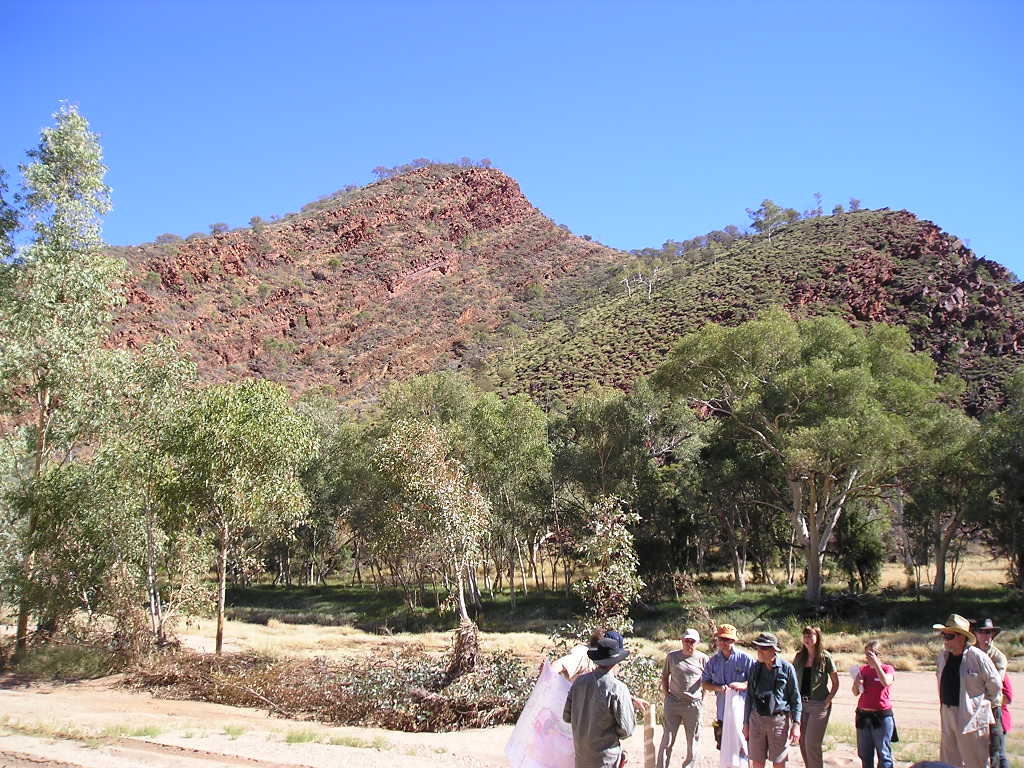
The highlight of the conference was the five-day pre-conference field trip (photos below) which looked at the Palaeozoic tectonothermal evolution of the Irindina Province of the eastern Arunta Region. The trip started out in Alice Springs, headed south through the Heavitree Quartzite Gap (the ridge is a wall just south of town, the rocks steeply dipping, with a couple of gaps where the "rivers" cut through--though how you can call a waterless stream course a river, I don't know). From there we took the sealed (read: "paved" if you happen to speak American) road east and thence north into the Strangways and Hearts Range metamorphic complex. As soon as we turned north we were on dirt roads, and stayed on them for most of the rest of the trip.

Each day saw us rise before the sun so as to have breakfast before hitting the road. We stopped at many interesting outcrops, and at each stop the trip leader would show us the map, remind us of the geology at the last stop, tell us about the current stop, and then let us know what the next stop held in store for us. By the end of the trip I had a good understanding of the geology of the region! There were just about 40 people on the trip, including the catering group. They took good care of us, feeding us well (even us fussy eaters with special dietary requirements), and provided "swags" for each of us--a sleeping bag, mattress, pillow and water-proof canvas cover for the lot. We slept each night on the sands of (dry) creek beds, under the stars. There was no rain, nor any clouds (nor would any have been expected), making the camp sites safe enough, though in rainy seasons (once every several years) flash floods would be a problem (see above mentioned post by Anne).

The conference itself was held in Alice Springs and, unlike the conference I attended in Melbourne the year before, had only one track of sessions, so there was never a problem deciding which talk to attend--we simply attended all of them! Most of the talks were interesting, quite a number were very, very well presented, and only one was bad.


Stop 1: Ross River Gorge

Stop 2: Bitter Springs Formation, view to the east

Stop 3 Arumba Sandstone

Stop 3B Ross River syncline

Stop 5 Strangways Metamorphic Complex, with lovely garnets (800C, 6Kbars)

Stop 6: fold in mylonite zone

Stop 7: Argument Gorge, mylonite zone

Stop 7: stretching lineations on mylonite surface (this was the first time I'd seen a good exposure of a mylonite, and suddenly everything I'd been reading about them made so much more sense!

Stop 9: garnet rich boudin (some exceed 1.5 cm)--I liked this stop!

Stop 9, garnet showing sense of shear

Stop 9: mafic layer + garnet sand

Stop 10: near Lizzy creek, view north to the Hearts Range

Stop 11: an old mica mine in a pegmatite dike. Note huge sheets of mica that still litter the ground


Stop 12 Bruna Granitic Gneiss--view to the east

Stop 13: Mt. Ruby garnet zone in amphibolite from the Hearts Range Metaigneous complex


Stop 14: Indiana Granite Hill. We climbed this one.
Us, at the top of Indiana Granite Hill (stop 14)

Stop 16: Huckitta Creek, Intense strain zone
Stop 16: folding
Stop 16: more of the intense strain


Stop 17: Large fold
Stop 17: large deformed pegmatite dike to the right of the above fold. Note boudins in the layers of the fold limb


Stop 19: fold in gneiss
Stop 19: view to the east


Stop 20: Bruna granitic gneiss:
Stop 20 garnet-rich metapelite:


Stop 20: a mylonite zone in gneiss. Note that the mylonite contains garnet, the gneiss does not.
Stop 21: a mica and garnet rich layer in gneiss:
Stop 21: folding in gneiss:

There was also a mid-conference filed trip--a one day trip to the west of Alice Springs, driving on sealed roads the entire time (in large tourist-style air conditioned busses). The person who sat next to me happened to have been from Tasmania, and graduated years ago from UTAS before moving to the mainland to do geology there. Needless to say we had some very pleasant discussions about the uni we both attended.
The rocks on the mid-confluence trip weren't as pretty (they hadn't been sufficiently deformed to show the pretty folding or nice minerals that we saw on the five day trip), but they were still nice, and we actually saw a few waterholes (one 30 feet deep) which stay wet year-round, despite the fact that the rest of the river course is dry.
Mid conference trip stop 1: looking west at the Arumba Sandstone
Mid-conference trip, stop 2 Elery water hole (and folding of the rocks)

Mid-conference trip Stop 3: anticline in Heavitree quartzite
Mid-conference trip Stop 3 Heavitree quartzite repeated above thrust fault
Mid Conference trip stop 3: Ormiston Gorge (with some nice folding showing)
Mid Conference trip stop 4: Mt. Saunders
Mid conference trip, stop 5: The waterhole at Glen Hellen Gorge

Note: all above photo captions were taken straight from the file names of the photo, I didn't have to look for my field notes from the trip today--I had the sense to give the photos meaningful names, including stop numbers and sometimes even P/T data promptly after taking them.

Sunday, 19 September 2010

word of the day

While reading a journal article* today I encountered a word I’d not noticed before: Aulacogen. The first mention in the article was "Continental extension that fails to lead to ocean opening and subsequently undergoes compression can occur at failed arms of ocean basins (aulacogens) and at intracontinental settings isolated from plate margins".

A quick check shows that there are 220 articles in scopus with that term used. (For comparison—“continental extension” yields 4,780 articles in scopus.) This is a somewhat specialized term, so I don’t feel bad that I missed noticing it (if, indeed, it has even been mentioned in the articles and textbooks I’ve read hitherto). Thus far my research has focused on the results of compression, be it deformation or metamorphism, rather than extension, so there would be no reason for me to think about what happens when extension starts and then stops before an ocean basin forms.

*Cawood, P. A., Kröner, A., Collins, W. J., Kusky, T. M., Mooney, W. D. and Windley, B. F. (2009). Accretionary orogens through Earth history. Geological Society Special Publication: 1-36.

Friday, 17 September 2010

two days of playing tourist amongst more than a month of travel

When I first scheduled my late summer conference travel schedule it sounded like a good idea to attend first the IMA conference in Budapest, go from there to Vienna for a short-course on the Kinetics of Geological Materials, from there to the European Textile forum, and from there to the Italian SIMP conference. Indeed, I very much enjoyed each of them, in very different ways. However, after 3.5 weeks of non-stop travel and major time commitments happening each day (and, for the last couple of weeks very, very limited internet access), I find that this week has been one of recovery. I’ve accomplished the urgent tasks on my to-do list, but mostly I’m catching up on personal correspondence and basic housekeeping tasks. Now it is time to start blogging once again.
I will start with sharing photos from my weekend as a tourist. Since I had two whole days off between the Budapest conference and the start of the short course in Vienna I decided that it would make more sense to play tourist than to fly home and then head right back out again. Having many fond memories of a salt-mine tour I took with my father when I was a child of five years of age, I decided that I would take the train up to Salzburg and check out the mine again, now that I’m a geologist and will have a better understanding of what I am seeing. However, when I asked my mother she didn’t remember which of mines we went to all those years ago. Since there is more than one to choose from, I made the decision between them the easy way and went with the one recommended by my host—I choose to do CouchSurfing that weekend, so that I’d meet local people rather than staying on my own in a hotel room.
Since the weather in Budapest had been extremely hot and sunny, I was delighted with the cool grey clouds and gentle rain in the Salzburg area. Here is the view from the mine entrance in Hallein:

It was so very wonderful to be surrounded by mountains again—I have missed them so!
The rock in the mine has clearly undergone some deformation looking at the layers on the wall:


Being a tourist mine they have some old-style ore-carts full of rocks ready to haul away:


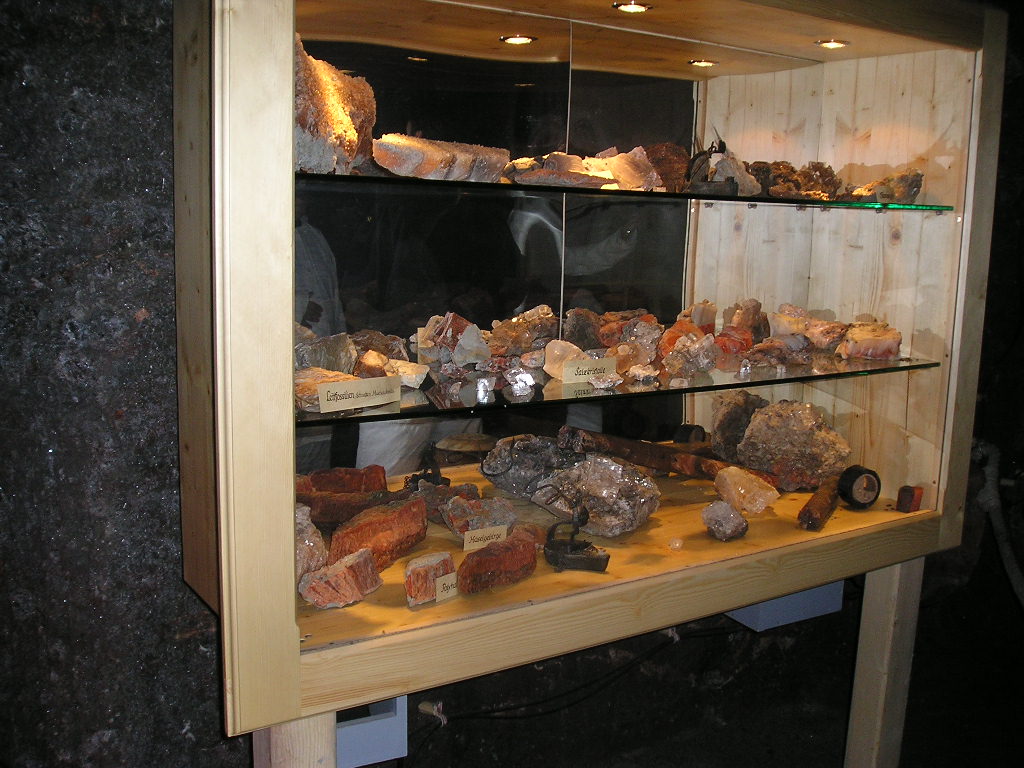
And a lovely display case of pretty samples from the mine:


Occasionally we could look up into a shaft reaching up to other levels:


They have a large lake in the mine that was used for mining—they put in fresh water, it dissolved salt from the rock, and they extracted and evaporated the brine. This silly statue has a slow, steady, drip of salt brine from the pump, and we were encouraged to taste it if we liked. Yup. Salty.


Alas, my photos from the rat trip across the lake didn’t come out. They do that part accompanied with eerie mood music and a light show. Made for an interesting effect, but felt like a scene from a fantasy movie, and not a real salt mine. This wall is from the far side of the lake:


Without a doubt the highlight of the trip was the slide between levels. This first photo is from the top of the shorter, warm-up slide:


And this photo is from the bottom of the longer slide:


It was so much fun that I climbed the stairs and went down the slide a second time. I can remember a slide from when I was a child, but I sure don’t remember it being this long or this fast. On the other hand, I do remember it as being a long way to fall sidewards if you weren’t wedged in between two grown-ups. This slide doesn’t have a place to fall to the side.

After leaving the mine I decided to walk the 3 km back down the hill to the town, rather than taking a bus, and I’m glad I did—I found a trail so that I didn’t even have to walk along the road.


And finally, the view back up the hill from the town:


I think that my early childhood visit to this mine, and the box of salt rocks that my dad bought me then, was a factor in my growing up to become a geologist. I loved my tour as a child, and found it just as delightful now. There is something comforting about having an entire mountain over my head. In hopes of encouraging the tradition I bought a box of salt rocks to send back to my nieces. This purchase was done with my sister’s encouragement, of course—she was too little to do the mine tour when we were there all those years ago, but she used to enjoy playing with (and licking) my salt-rocks.