Rock dust being a nasty thing to breath, the first thing one does when entering the crushing room is turn on the ventilation system. It is recommended that in addition to that one wear a breathing mask. Once the ventilation system is functioning it is very important to clean all of the work surfaces and tools carefully, to be certain that there isn’t any remaining dust from previous samples—it is important that the zircons we collect at the end of the separation process actually came from the sample we think they did!
The hydraulic crusher, cleaned and ready to use:

A sample in the crusher, ready to crush:

A clean sheet of paper (scrap, rescued from the recycle bin upstairs) is placed under the sample to make it easier to transfer the chips to the mill in the next step. Alas, the paper does tend to get destroyed, and it requires a bit of scrubbing to remove the tiny bits of it which get squished onto the underlying metal surface, but it really does make the process easier, so is worth that extra effort.


With a push of a button, the hydraulic crusher lowers the upper head inexorably onto the sample, and, eventually, there is brittle failure of the rock.
The chips are then put into the ring mill, which had first been completely cleaned and completely dried:


the mill is taken to the milling machine, set into place, and the hydraulic clamp lowered to hold it securely. (The compressed air system in use here is essential for nearly every step of the process!)


Then the lid closed, and the machine is turned on for 3 to 5 seconds (depending on how hard this sample is).

While the machine is on the mill is shaken in such a way as to cause the internal rings to rotate and move about inside the mill, crushing the rock chips into sand.


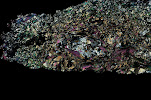
Once the mill stops shaking one takes the sand out, pours it into a clean bag, with the sample number clearly marked upon it, and then the real work begins: scrubbing the mill, the counters, the crusher, and anything else which might have come into contact with the dust/sand from the sample. One of the challenges is cleaning the rubber collar from the hydraulic crusher, because it has many small cracks on the internal edge, from years of sometimes having been crushed along with some of the samples. It is very important to make certain that no sand remains trapped in these cracks.

Once everything is clean, and fast-dried with the compressed air gun (which will, it is hoped, blow away any tiny zircons which might have stuck to the surface during the washing process) it is time to start again on the next sample. So far I’ve turned 16 samples into sand,


with an average time of 30 minutes per sample, 3 seconds of which is the actual transformation process. There are five more samples to go on this job. One of the joys of crushing someone else's samples is that I have no idea where they come from, or what their significance is, so that I'm free to just appreciate each one on its own merit, admiring the igneous crystallization in this one, the fine banded metamorphic texture in that one, or the rich red hue of the sand of a third.
Next week I will turn rocks into powder for XRF chemical analysis. This will take much longer—the powder needs to be quite fine grained, so I will have to give it 15 seconds in the mill, instead of just 3 to 5. The cleaning process before and after each sample, however, will be unchanged. The need to avoid contamination is just as great for chemical analysis as it is for zircon separation.




 Posts
Posts

