Showing posts with label metamorphism. Show all posts

Friday, 15 April 2011

Metaphorical rocks

I have been taking a language class since moving to Scandinavia so that I can learn to understand the local language. Last week we had a homework assignment to write about our new city, and there was an essay in the textbook that we could use as an example/inspiration for our own writing.

Being a geologist with little interest in cities my essay didn't look much like the one in the book, which focused on various tourist destinations in a major Scandinavian city. Instead I spoke about the fact that January was a good time to arrive here because then it is cold enough it doesn't rain, mentioning that I do not care for rain in the winter, but I love snow, and find the ice-crystal covered trees much prettier than bare trees. From there I went on to discuss the interesting people I have met, and ending with a paragraph explaining that I am looking forward to summer because then I will be able to see the rocks; I have been told that the local rocks are ______, and that is the prettiest rock type.

The word I had in that blank was meant to be "metamorphic". However, when I asked my favourite on-line dictionary for the local word for "metamorphic" it didn't know the word, so I instead called upon Google Translate, which helpfully provided me the word "metaforiska", so I used it. However, when the teacher returned my essay she wrote on the page "metaphorical? Is that really what you meant?" Oops! Checking Wikipedia the local language it turns out that the word I should have used was metamorfa.

However, when I think of it further, it occurs to me that, perhaps, I did choose the correct word after all. Metamorphic rocks, can, indeed, serve as a metaphor for life. In this world we are born as soft, yielding creatures (babies = ocean floor sediments). Over time we are subject to heat and pressure ( = rules from parents & society) which gradually transform us into first older children (phyllite) and then teenagers (low grade schist) and finally mature adults (high grade schist, mylonite, or even migmatite) with the record of our experiences both moulding who we are as people and leaving a permanent record in our souls (zoning in porphyroblasts, inclusion trails, flow banding, etc…) The more difficult the life, the more character we develop, and the stronger we need to be (which is why the prettiest rocks are the ones which are most deformed).

Friday, 1 April 2011

links to other blogs

I just read a wonderful series of posts by Life in a Plane Light describing how metamorphic reactions turn boring old mud into beautiful garnet schist. If anyone missed it, part one talks about the factors that make up metamorphism, the second talks about the first changes that happen to the mud when heat is applied, and the third adds deformation into the equation and gets us to the garnet. If you haven't read them yet they are so worth a look.

Wednesday, 17 November 2010

I may have missed the GSA meeting, but…

I just saw a post by Life in a Plane Light which really makes me wish that I had been able to attend the Fall GSA meeting this year. As a metamorphic petrologist I love garnet. Sure, it is a pretty mineral, but the usefulness of this mineral in learning about the history of metamorphic rocks is what makes it truly fascinating. Fortunately, while I may not have been able to attend the session on Garnet and Its Use in Unraveling Metamorphic and Tectonic Processes , the abstracts are available on line to read at will. I've just done well more than my 1000 words of reading from the geologic literature reading these abstracts, and wondering why I hadn't thought of looking at the program sooner. Just because one can't attend a meeting doesn't mean one can't benefit from the information that is shared there.

Friday, 24 September 2010

Deformation in the Desert field trip 2007

Today I read a post by Anne over at Highly Allochthonous on some major flooding she witnessed on her trip to Alice Springs in 2000. This reminded me of my one trip to Alice Springs (it wasn’t flooding when I was there). Since my trip pre-dates my starting this blog, I thought I’d share with you the write-up I did for friends and family.

The below was written on 14 July 2007.

I just returned from the "Deformation in the Desert" Conference, held in Alice Springs, Northern Territory, Australia, sponsored by the Geological Society of Australia Specialist Group in Tectonics and Structural Geology.

The highlight of the conference was the five-day pre-conference field trip (photos below) which looked at the Palaeozoic tectonothermal evolution of the Irindina Province of the eastern Arunta Region. The trip started out in Alice Springs, headed south through the Heavitree Quartzite Gap (the ridge is a wall just south of town, the rocks steeply dipping, with a couple of gaps where the "rivers" cut through--though how you can call a waterless stream course a river, I don't know). From there we took the sealed (read: "paved" if you happen to speak American) road east and thence north into the Strangways and Hearts Range metamorphic complex. As soon as we turned north we were on dirt roads, and stayed on them for most of the rest of the trip.

Each day saw us rise before the sun so as to have breakfast before hitting the road. We stopped at many interesting outcrops, and at each stop the trip leader would show us the map, remind us of the geology at the last stop, tell us about the current stop, and then let us know what the next stop held in store for us. By the end of the trip I had a good understanding of the geology of the region! There were just about 40 people on the trip, including the catering group. They took good care of us, feeding us well (even us fussy eaters with special dietary requirements), and provided "swags" for each of us--a sleeping bag, mattress, pillow and water-proof canvas cover for the lot. We slept each night on the sands of (dry) creek beds, under the stars. There was no rain, nor any clouds (nor would any have been expected), making the camp sites safe enough, though in rainy seasons (once every several years) flash floods would be a problem (see above mentioned post by Anne).

The conference itself was held in Alice Springs and, unlike the conference I attended in Melbourne the year before, had only one track of sessions, so there was never a problem deciding which talk to attend--we simply attended all of them! Most of the talks were interesting, quite a number were very, very well presented, and only one was bad.


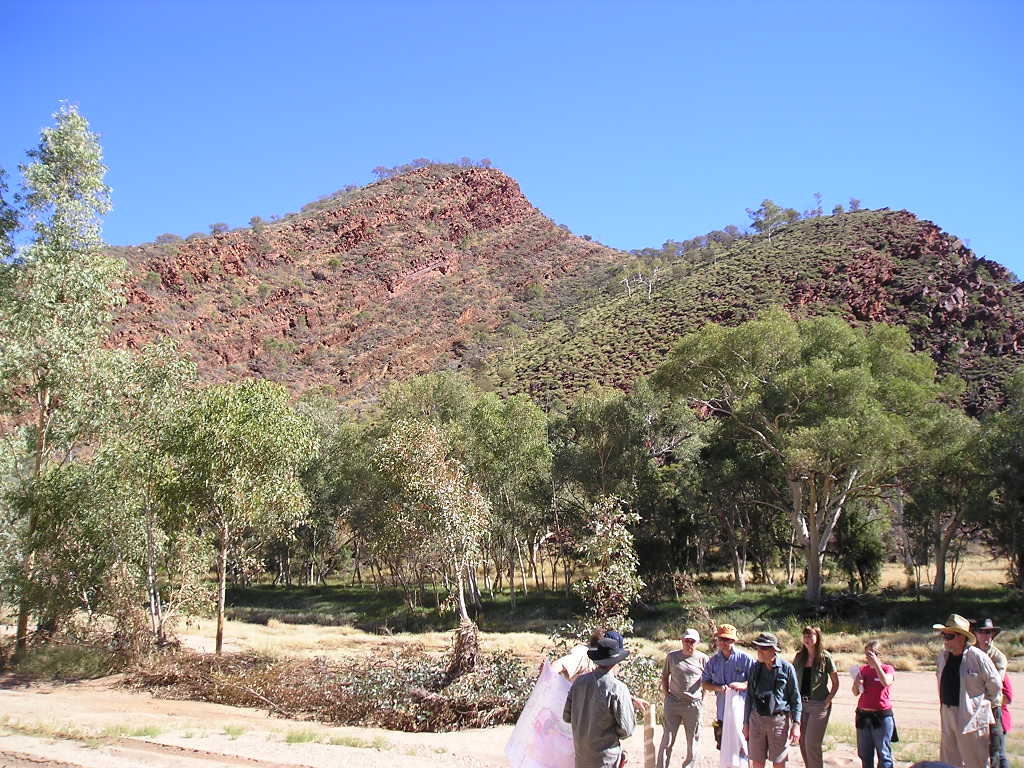
Stop 1: Ross River Gorge

Stop 2: Bitter Springs Formation, view to the east

Stop 3 Arumba Sandstone

Stop 3B Ross River syncline

Stop 5 Strangways Metamorphic Complex, with lovely garnets (800C, 6Kbars)

Stop 6: fold in mylonite zone

Stop 7: Argument Gorge, mylonite zone

Stop 7: stretching lineations on mylonite surface (this was the first time I'd seen a good exposure of a mylonite, and suddenly everything I'd been reading about them made so much more sense!

Stop 9: garnet rich boudin (some exceed 1.5 cm)--I liked this stop!

Stop 9, garnet showing sense of shear

Stop 9: mafic layer + garnet sand

Stop 10: near Lizzy creek, view north to the Hearts Range

Stop 11: an old mica mine in a pegmatite dike. Note huge sheets of mica that still litter the ground


Stop 12 Bruna Granitic Gneiss--view to the east

Stop 13: Mt. Ruby garnet zone in amphibolite from the Hearts Range Metaigneous complex


Stop 14: Indiana Granite Hill. We climbed this one.
Us, at the top of Indiana Granite Hill (stop 14)

Stop 16: Huckitta Creek, Intense strain zone
Stop 16: folding
Stop 16: more of the intense strain


Stop 17: Large fold
Stop 17: large deformed pegmatite dike to the right of the above fold. Note boudins in the layers of the fold limb


Stop 19: fold in gneiss
Stop 19: view to the east


Stop 20: Bruna granitic gneiss:
Stop 20 garnet-rich metapelite:


Stop 20: a mylonite zone in gneiss. Note that the mylonite contains garnet, the gneiss does not.
Stop 21: a mica and garnet rich layer in gneiss:
Stop 21: folding in gneiss:

There was also a mid-conference filed trip--a one day trip to the west of Alice Springs, driving on sealed roads the entire time (in large tourist-style air conditioned busses). The person who sat next to me happened to have been from Tasmania, and graduated years ago from UTAS before moving to the mainland to do geology there. Needless to say we had some very pleasant discussions about the uni we both attended.
The rocks on the mid-confluence trip weren't as pretty (they hadn't been sufficiently deformed to show the pretty folding or nice minerals that we saw on the five day trip), but they were still nice, and we actually saw a few waterholes (one 30 feet deep) which stay wet year-round, despite the fact that the rest of the river course is dry.
Mid conference trip stop 1: looking west at the Arumba Sandstone
Mid-conference trip, stop 2 Elery water hole (and folding of the rocks)

Mid-conference trip Stop 3: anticline in Heavitree quartzite
Mid-conference trip Stop 3 Heavitree quartzite repeated above thrust fault
Mid Conference trip stop 3: Ormiston Gorge (with some nice folding showing)
Mid Conference trip stop 4: Mt. Saunders
Mid conference trip, stop 5: The waterhole at Glen Hellen Gorge

Note: all above photo captions were taken straight from the file names of the photo, I didn't have to look for my field notes from the trip today--I had the sense to give the photos meaningful names, including stop numbers and sometimes even P/T data promptly after taking them.

Tuesday, 17 August 2010

Article review: “Metamorphism: from Patterns to Processes”

As a member of the Mineralogical Society of America I receive a paper copy of the journal, Elements, each month. Some of there previous issues have focused upon a specific element or a specific mineral. The June 2010 issue (Vol 6, #3), on the other hand, focuses on Fluids in Metamorphism. Needless to say, as a metamorphic petrologist this caught my attention. I’ve just finished reading the article titled Metamorphism: From Patterns to Processes by Bjørn Jamtveit, who is located at the Center for Physics of Geological Processes at the University of Oslo and decided that it is worth mentioning here.

This article is a very good one for underscoring one of the reasons I am fond of metamorphic rocks: they are pretty! He includes a variety of figures to illustrate the types of changes that happen to rocks as a result of metamorphism (change), with a focus on how those changes are facilitated by the presence of fluids. As a teaser for the article, I have copied his figure 1 below. The first photo is of a dark, fine grained basalt (formed by the cooling of lava after it erupted from a volcano), which contains the minerals augite, plagioclase, and olivine, though the individual grains of each are too small to see at this scale. The second photo is of a lovely eclogite, which contains red garnets, green omphacite, and white clinozoisite, all of which are much coarser-grained than minerals in the basalt. Metamorphic processes are responsible for the transformation of basalts into eclogites.


The differences in the crystal structures of augite-plagioclase-olivine vs. garnet-omphacite-clinozoisite mean that the eclogite is a denser rock (~3.5 g/cm3) than is the basalt (2.9 g/cm3), which, the figure caption tells us, means that the transition from one to the other is important for large-scale geodynamic processes, including basin subsidence and subduction.

In addition to illustrating the beauty of metamorphic rocks, the article also touches upon the factors that cause the change, and how long these processes take. I highly recommend it to anyone curious about metamorphism.

Monday, 2 August 2010

Why Garnet?

A friend of mine recently asked me “Why garnet?”, and it occurred to me that others might also like to hear one petrologist’s thoughts as to why it is such a well-studied metamorphic mineral.
1. They are pretty!
2. They are very common in a wide rang
e of metamorphic rock types.
3. They are stable across a reasonably broad range of pressures and temperatures of relevance for metamorphism.
4. The often form “porphyroblasts” (metamorphic crystals that are noticeably larger than those which surround them).
5. They are easy to identify in hand-samples—their nice “garnet-red” colour often contrasts with the other minerals in the sample (though some of the less common varieties come in other colours, including green and yellow).
6. They are easy to identify in thin-section (a slice of rock only ~3 microns thick, which means that light transmits through most of the minerals so that one can look at it in an optical microscope): they have a high “relief” (they look like they are taller than the things next to them, even though they aren’t) and they are isotropic (they are solid black when the polarizing filters are crossed, no matter how the stage is turned, making them stand out against the changing bright blues, pinks, and yellows that the other minerals become when the polarizing filters are crossed).
7. They have a rather broad range of possible chemical compositions, with iron, magnesium, manganese, and calcium all able to slot into the same position in the crystal structure (this is part of what gives it a broad range of stable temperatures and pressures) and aluminum and silica can also do a certain amount of swapping one for the other. There are a handful of other, less common elements which can also substitute for others in its crystal structure.
8. They have very slow diffusion, which means that once they reach a certain size the center of the grains no longer get involved in chemical reactions. As a result it is normal for the composition of garnets to be “zoned”, with the center containing more Mn than the rims, and the rims containing more Mg than the core (each of the other major elements also typically change their concentration from core to rim).
We metamorphic petrologists talk about the garnet cores being “armored” by the rims. The rims are, in theory, in equilibrium (or trying to achieve equilibrium) with the matrix minerals at any given time—this means that the minerals present will be participating in the chemical reactions that are causing the growth of some minerals and the dissolution of others. For many minerals the normal grain size is small enough that the reactions involve the entire grains, but garnets often grow large enough that only the outermost shell is involved in the reactions, with the inner portion “freezing” in whatever composition was stable when it was the outer portion.
So, just as an Everlasting Gobstopper (do they still make those candies?) changes colors as you suck on it, so garnets show a range of compositions from core to rim. Part of the changes in garnet composition are due to rare ingredients having been used up making garnet (plus or minus any other zoned minerals present). So Mn, which tends to prefer garnet to any other mineral in metamorphic rocks, starts out “high” in garnet, but there is usually so little of it available in any given metamorphic rock it is soon used up and the garnets have gradually less and less Mn as they grow, until eventually the outer portions have no measurable Mn at all. The other reasons garnets change their composition is due to changes in pressure or temperature. Different recipes of garnet are stable at different pressures and temperatures. So if the conditions change different types of garnet grow on the outside of the pre-existing garnet. These features all combine to make it a very well-studied mineral because of all of the inform
ation one can extract about the history of the rock.

A large garnet in the wild (southwest coast of Tasmania, photo taken by Andrew McNiel):

Garnets (2mm) in thin-section from Collingwood River, Tasmania (also shown are biotite (brown), muscovite (pale but wavy lines), quartz (colorless and without lines + dots in the garnet):

Same garnets as above, but in crossed-polarized light:


Monday, 17 May 2010

Barrow’s kyanite zone

It has been a while since I made time to play in the Accretionary Wedge. This month the topic asks us to share (a) geologically significant photo(s). This announcement reminded me that I never did type up a summary of the field trip I did last year after the MAPT conference, so I’ll share a couple of photos from that trip, and explain why they are important.

The field trip went to look at the area Barrow made famous when he used it to formulate his theories on metamorphic facies. The Dalradian series is located just north of the Highland Boundary Fault in Scotland. Different parts of the series were metamorphosed at different pressures/temperatures, which resulted in different combinations of minerals in each area, though the composition of the rocks is similar.

In our field trip we started out near the fault, and stopped in each of the key areas along the way, visiting outcrops of the chlorite zone, the biotite zone, the carnet zone, and the kyanite zone. Most of the geologists on the trip are accustomed to looking at rocks in thin section, where, once you’ve learned how to identify them, it is a very easy matter to identify minerals and tell at a glance which zone the rocks come from. However, when Barrow did his field work in this area, he did it largely without thin sections—instead he looked at the rock outcrops themselves, and broke off pieces with his hammer and looked at them in the field.

The man was a talented enough petrologist that he was able to identify the minerals in the field, and to tell when he’d moved from one mineral assemblage to the next. Having spent a rainy day tramping around the lower part of the Scottish Highlands accompanied by geologists who knew in advance what minerals to expect in each outcrop, I still had difficulties spotting the index minerals in the outcrops. Or rather, I did, until we reached the kyanite zone. There is simply no mistaking the large blue crystals of kyanite in these rocks!